
What problem it solves
When an employee leaves a job in Sierra Leone, they are owed an end-of-service benefit (EOSB): a lump sum based on their salary and how long they worked. If that money stays on the employer’s own books, the benefit is only as safe as the business. The EOSB platform changes that. Each employer pays the benefits it owes into an EOSB trust: money held apart from the business, controlled by an independent trustee and invested by a fund manager. The platform keeps the national record of what is owed, what has been paid in, how it is invested and what has been paid out. The Ministry of Employment, Labour and Social Security (MELSS) oversees it.Who takes part
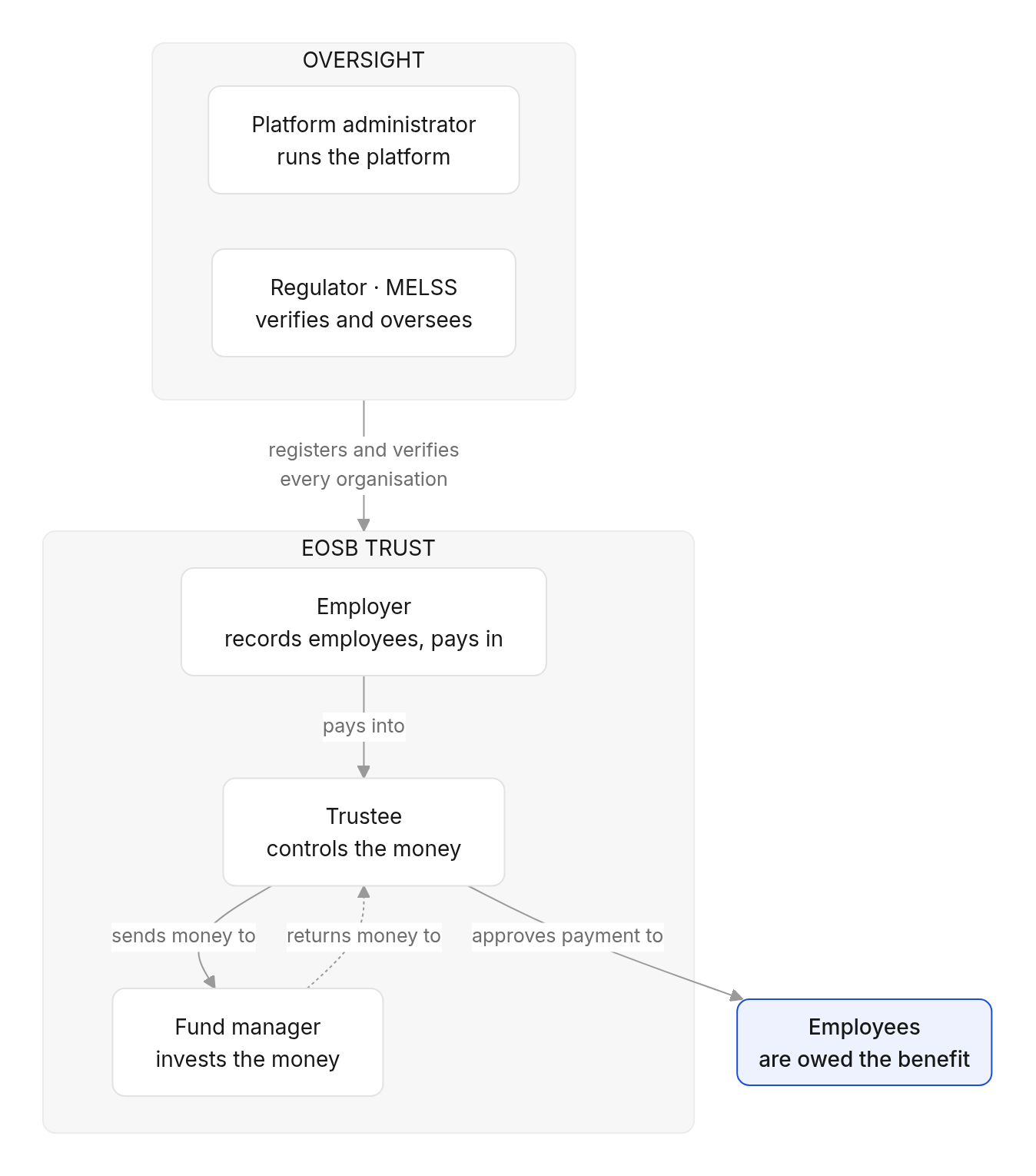
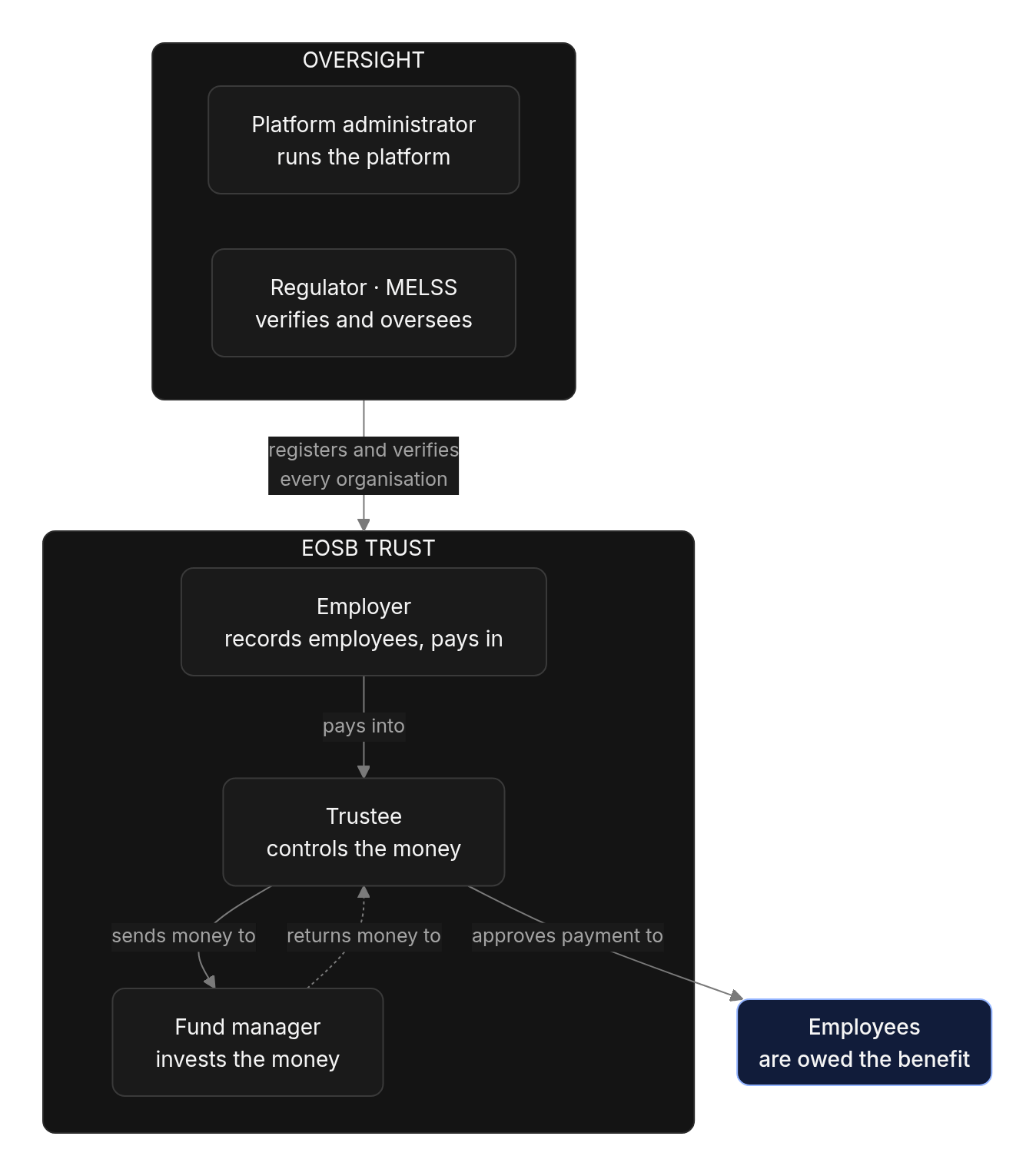
More detail: Roles and responsibilities. The rules each role works under, and the requirement each comes from: Business rules.
The three things the platform tracks
What is owed
Every employee’s benefit, calculated from salary and service and updated every month. Added up, this is the employer’s liability.
Where the money is
Every payment into the trust, every transfer to and from the fund manager, every expense and every payout.
How it is invested
What the fund manager has bought, what it is worth, and how it compares with the agreed policy.
The life of an employer on the platform
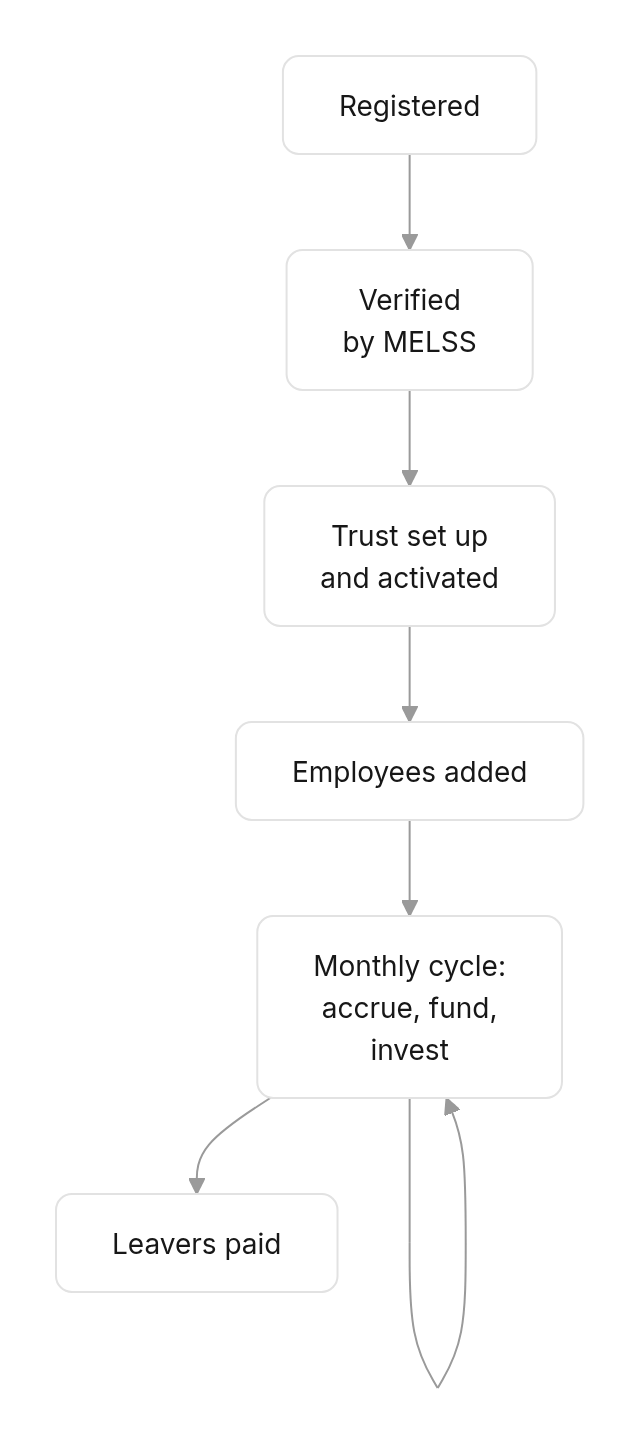
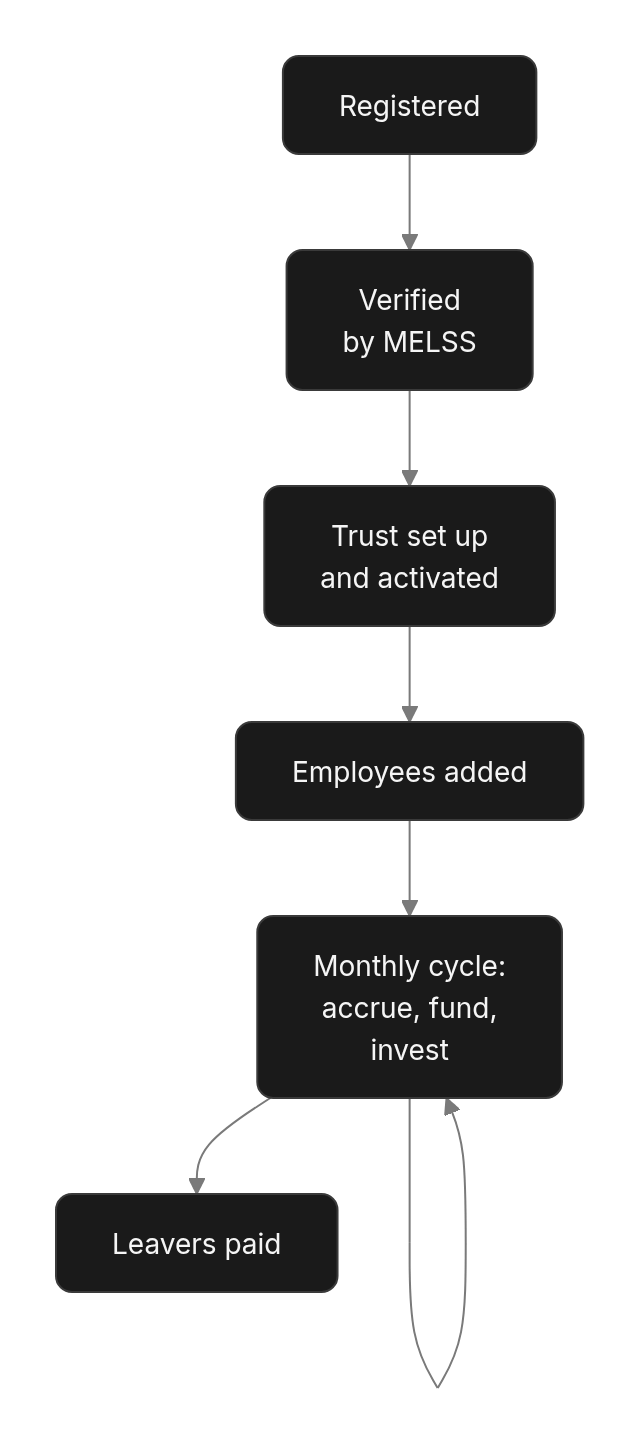
- Onboarding. The administrator registers the employer, the regulator verifies it, and the administrator sets up its trust. See Onboarding.
- Employees. The employer registers its staff. Each one’s benefit is calculated from day one of their service. See The employee lifecycle.
- The monthly cycle. Benefits grow every month; the employer pays in; the trustee confirms and passes money to the fund manager to invest. See The monthly cycle.
- Leavers. When an employee leaves, their benefit is approved by the trustee and paid by the administrator.
Principles that run through everything
Two people for every important decision
Two people for every important decision
Whoever starts an action is never the one who approves it. The employer submits a payment, the trustee confirms it. The fund manager proposes a budget, the trustee or employer approves it. See Approvals and controls.
Evidence for every movement of money
Evidence for every movement of money
Payments, transfers, expenses, purchases and write-offs each carry a document — a bank advice, invoice or contract note — that the next person can open and check.
One-time codes where money moves
One-time codes where money moves
Actions that move or release money ask for a 6-digit code sent to the person’s phone and email, so a stolen password alone is not enough.
Nothing is deleted
Nothing is deleted
Mistakes are corrected by rejecting, reversing or recording a new entry, never by erasing. Every action is recorded with who did it and when.
Each trust's money is kept separate
Each trust's money is kept separate
Every amount belongs to one trust. A fund manager holds a separate cash account for each trust it manages, and one trust’s money is never used for another.